NURA for Institutions

Institution-ready AI curriculum with the rigor, structure, and rollout support serious buyers expect.

NURA helps institutions deliver structured AI learning with curriculum, labs, assessments, progress visibility, and exportable learner work, without reducing AI instruction to disconnected demos or surface-level prompting.

Built for institutions that need a credible AI learning offer, not just another enrichment add-on.
Structured
curriculum from AI foundations through capstone work
Measurable
assessments, checkpoints, and exportable evidence of learning
Rollout-ready
support for pilots, classrooms, programs, and larger implementations
What institutions are buying
SchoolsDistrictsProgramsDepartments
  • Curriculum that feels credible to educators and tangible to decision-makers
  • Hands-on labs that help learners understand how models are actually built
  • Assessment and progress visibility that make adoption easier to justify
  • Implementation support for pilots, classrooms, schools, and organization-wide use
Designed to help institutions adopt AI instruction with more confidence, clearer outcomes, and less guesswork.
What institutions can expect
A structured curriculum, hands-on labs, measurable assessments, and rollout support designed to help institutions launch AI learning with more confidence and less friction.
Who this is built for
  • Schools and districts building a more serious AI offering
  • Teachers and departments that need structure, not scattered AI activities
  • Programs that want measurable outcomes, exportable artifacts, and rollout clarity
  • Institution leaders evaluating whether the curriculum can scale cleanly

A clear path to piloting NURA

See the platform, evaluate the fit, and decide whether a pilot makes sense for your class, program, school, or district.

01
See the product clearly
Review the curriculum, builder experience, and implementation fit without guessing what is actually included.
02
Choose a pilot scope
Start with a class, program, school, or district-level test depending on how your institution adopts new offerings.
03
Evaluate with real evidence
Use learner work, assessments, and instructional visibility to decide whether the platform should expand.

Hands-on AI learning with the NURA builder

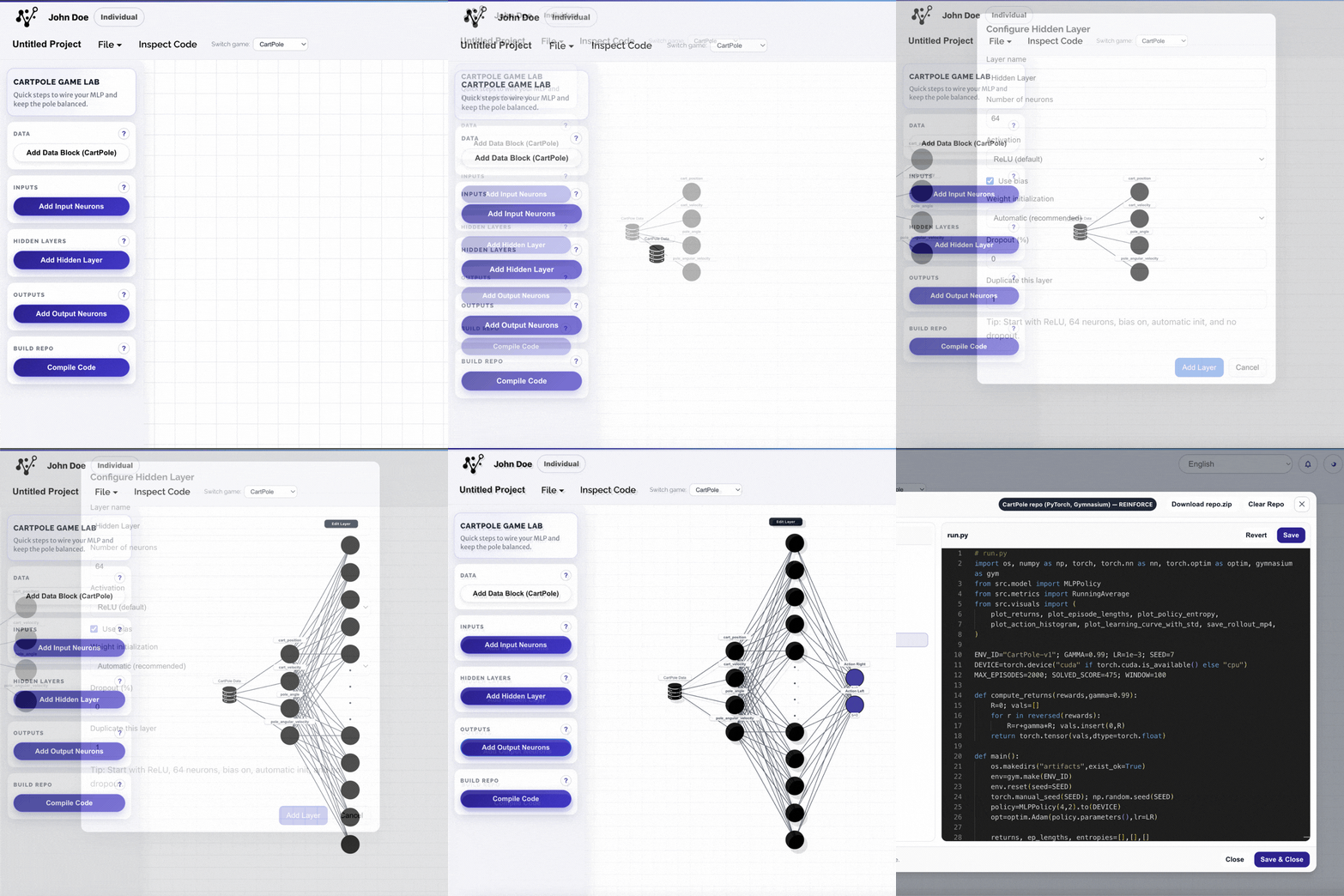
The builder shown here is part of the learning experience. Students and educators use it to understand architecture, train models, observe outcomes, and connect concepts to real hands-on work.
Learning Builder
Visually build, train, and test models as part of structured AI instruction.
Low-code multilayer perceptron builder training CartPole
Preview
Learn by building
Students work through model construction visually instead of only reading about concepts.
See architecture in motion
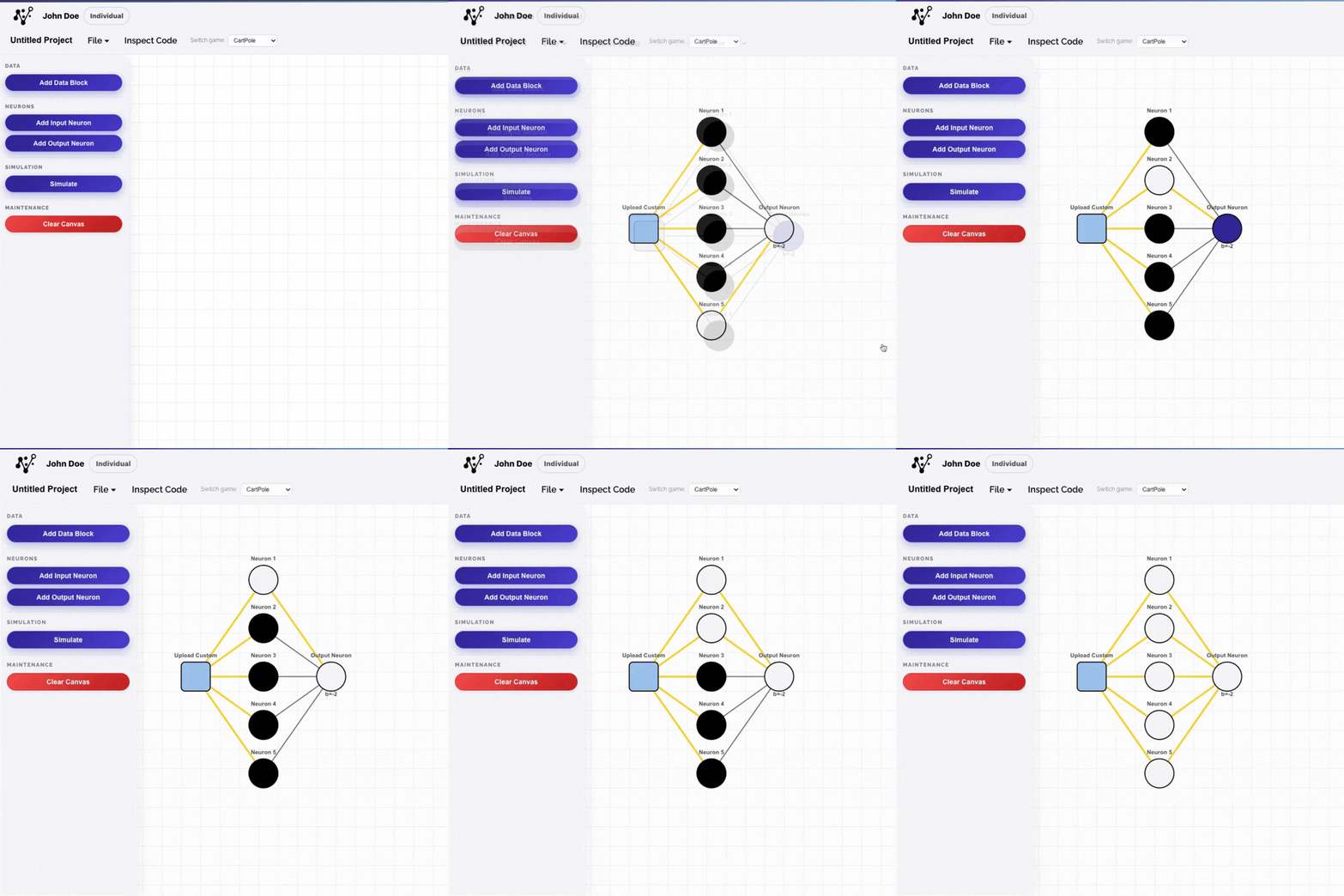
Make layers, activations, and outputs more understandable through direct interaction.
Turn concepts into outcomes
Support labs, projects, and exportable work that reinforce instruction with real artifacts.
Concept to comprehension
Use guided visual workflows to connect theory, experimentation, and student understanding.
Perceptron activation and output walkthrough
Preview
Learning-builder outcomes
  • Stronger understanding of how models are structured and trained
  • Hands-on labs that support curriculum, assessment, and engagement
  • Clearer instructional moments for teachers and program leaders
  • Projects and outputs that show actual learner progress

A real AI course structure, not a content dump

The curriculum should feel teachable, measurable, and sequenced for real instructional environments, while still keeping the full lesson map protected.

Videos
Concept-first explanations and demos.
Readings
Reinforce foundations with clarity and structure.
Knowledge checks
Low-stakes checkpoints to prevent gaps.
Activities / labs
Builder-based practice: construct, train, observe.
Quizzes
Unit validation tied to what was built.
Midterms
Prove understanding across multiple units.
Finals
Capstone-level evidence and exportable work.
edu-l1 • Beginner AI Foundations

Curriculum overview: beginner AI Foundations

This preview helps schools and program leaders understand what students actually move through, without exposing every lesson in the pathway.

Pathway at a glance

Foundations first. Builder fluency second. Project proof at the end.

The sequence is designed to show a credible progression from AI fundamentals and data reasoning into model architecture, tooling fluency, full builds, and a capstone.

10 modulesMidterm checkpointCapstone projectFinal assessment
  • Differentiate AI, automation, prediction, and intelligence in practical terms.
  • Spot the kinds of problems AI can and cannot solve well.
  • Recognize common failure points before moving into technical work.
VideoReadingLabQuiz
  • Work with examples, features, and labels as the core language of supervised learning.
  • Understand how labeling decisions shape model behavior.
  • Evaluate data quality, bias, train/test splits, and confidence with more discipline.
VideoReadingLabQuiz
  • Break down inputs, weights, bias, and step activation without black-box thinking.
  • Use truth tables and tuning exercises to build intuition about model behavior.
  • See why linearly separable problems matter and where simple models hit their limits.
VideoReadingLabQuiz
  • Navigate IDEs, Python basics, and the file structures behind real projects.
  • Build confidence with folders, repos, libraries, and working environments.
  • Develop the practical fluency that makes later modeling work smoother.
VideoReadingLabQuiz
  • Review the logic chain from AI concepts through tooling readiness.
  • Demonstrate understanding across Modules 0 through 3.
  • Identify where additional reinforcement is needed before moving deeper.
ReviewMilestoneAssessment
  • Understand hidden layers, nonlinearity, and the forward pass at a conceptual level.
  • Compare simpler and deeper network structures with more precision.
  • Build stronger intuition for why architecture changes outcomes.
VideoReadingLabQuiz
  • Decide whether AI is actually needed before building.
  • Frame the task type, likely inputs, and success criteria more clearly.
  • Assess builder-readiness so projects start with better structure.
VideoReadingLabQuiz
  • Set up an end-to-end build inside the model builder.
  • Train, diagnose, and improve results through deliberate iteration.
  • Connect conceptual understanding to practical training decisions.
VideoReadingLabQuiz
  • Choose a problem worth solving and collect the right supporting data.
  • Configure the builder, run training, and improve weak results.
  • Leave with a project that demonstrates applied AI thinking, not just completion.
VideoReadingLabQuiz
  • Synthesize the full progression from foundations to model building.
  • Demonstrate stronger vocabulary, reasoning, and builder confidence.
  • Finish with a clearer picture of what comes next in the learner journey.
FinalReviewAssessment

Built for schools, districts, and teacher-led rollout

The learn path remains the education product: LTI 1.3 integration, classroom access, progress visibility, and organization-level rollout support.

LTI 1.3 integration
  • Fits LMS workflows
  • Simplified access & launch
  • Designed to scale deployment
Rosters & roles
  • Student/teacher provisioning
  • Role-based access controls
  • Section/class organization
Reporting & insights
  • Progress and mastery visibility
  • Assessment analytics
  • Intervention support
Next step

If the product looks right, the next move is to try the pilot with your institution.

Start the conversation for your class, after-school program, school, or district and we can help scope the right pilot path.

Contact

Tell us whether you’re exploring NURA for your institution or for your own learning, and what success should look like.

We’ll respond within 1–2 business days.